
-
 The Return to Work
What happens if your workplace reopens before you're ready to return or you're an essential worker? For some people who have been diagnosed with cancer, accommodations may be possible.
by Jen Tota McGivney
-
 COVID-19 Exposes Health Inequities
At a symposium held during a virtual meeting of cancer researchers, panelists discussed the disproportionate impact COVID-19 has had on Black and Latino Americans, as well as members of other minority groups.
by Kevin McLaughlin
-
 Pushing Progress Forward
NCI Director Norman E. “Ned” Sharpless addresses disparities and maps out plans for the future amid “profound upheaval.”
by Kevin McLaughlin
-
 Embracing Palliative Care Sooner
Studies show the benefits palliative care can provide to advanced cancer patients, but also highlight inequities in access.
by Jen Tota McGivney
-
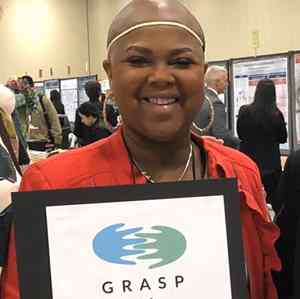 Cancer Patient Advocates Find Strength in Numbers
Patient advocates have become a vital part of the San Antonio Breast Cancer Symposium. Opportunities for advocates continue to multiply.
by Marci A. Landsmann
-
 Cancer Takes an Unequal Toll on Employment
In a study of women with breast cancer in North Carolina, those who lived in rural areas or were black were more likely than urban white women to report negative changes in their employment.
by Pamela Rafalow Grossman
-
 First Ladies of Africa Issue Call to Address Cancer Crisis
A coalition of wives of African leaders, originally dedicated to addressing HIV/AIDS, is now also taking on the growing problem of cancer.
by Bradley D. Miller, PhD
-
 HIV Can Worsen Cancer Treatment Outcomes
People with HIV who develop certain cancers are more likely to die from them than patients without HIV—even if they receive similar treatment.
by Jon Kelvey
-
 Why Is the Rate of Uterine Cancer Rising?
Uterine cancer incidence is increasing in the U.S., particularly in Hispanic, Asian and black women, but obesity may play a smaller role in this change than was previously assumed.
by Ashley P. Taylor
-
 Cancer Care on a Native American Reservation
For the first time, people living in the Navajo Nation who are diagnosed with cancer can get treated for the disease without leaving tribal lands.
by Kate Yandell
The ‘Your Friends & Neighbors’ actress explains how her diagnosis challenged many of her assumptions about breast cancer.
by Darlene Dobkowski
Why I Participated in a Clinical TrialWhen doctors told Yvonne McLean Florence she was eligible to participate in a research trial testing an experimental drug, she joined. She wants more people to have the same opportunity.
by Yvonne McLean Florence
Targeted Therapy Improves Pancreatic Cancer SurvivalA recently approved drug that targets RAS proteins meaningfully improves outcomes for people with this difficult-to-treat cancer.
by Sandra Gordon
Bring On the WavesA surfer’s love for the ocean guides her through breast cancer treatment and beyond.
by Cameron Walker
-
 AACR OMB Statement and Call to Action
The AACR is deeply concerned that proposed OMB regulations would disrupt federal research grant giving, severely weakening a program that has supported American medical innovation for decades.
-
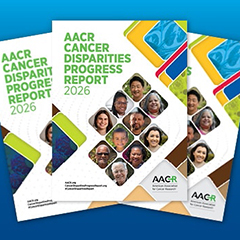 AACR Cancer Disparities Progress Report
The AACR Cancer Disparities Progress Report 2026 highlights recent progress in reducing cancer disparities and emphasizes the continued need for transformative research.
Cancer Research at a Crossroads
